

TWENTY FIRST GROUP
Evolution Saas
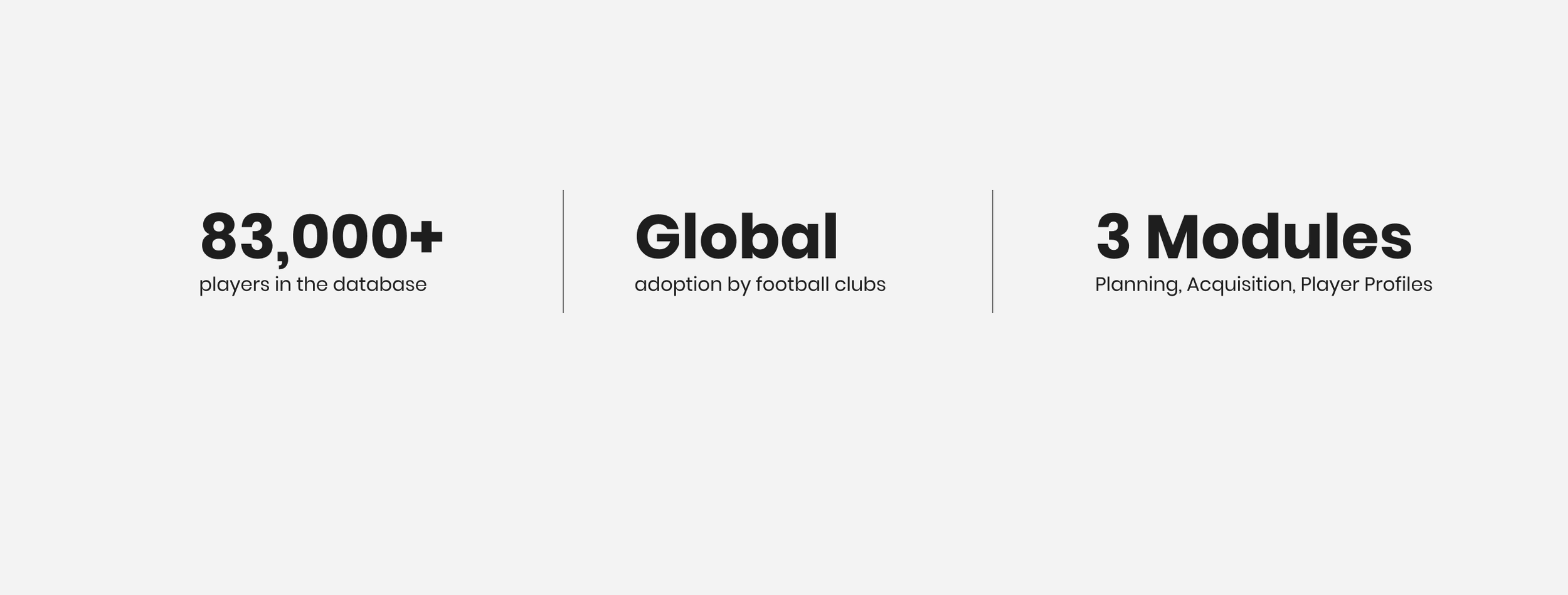
Leading the product design of an AI-powered talent identification platform used by the world's leading football clubs to reduce transfer risk, discover undervalued players, and make smarter squad-building decisions across a database of 83,000+ players.
THE PROBLEM
Football's biggest decisions were based on gut instinct
Transfer decisions in professional football involve millions of pounds and carry enormous risk. A single bad signing can destabilise a squad, drain a budget, and set a club back years. Yet most clubs were still relying heavily on traditional scouting networks, personal relationships, and subjective judgment to make these decisions.
Twenty First Group had built sophisticated analytical models that could assess player performance, physique, market value, and team fit using data. But the platform housing this intelligence, Evolution, needed to make that data accessible and actionable for a non-technical audience: boardroom executives, sporting directors, and club leadership who needed to make confident, high-stakes decisions quickly.
The design challenge wasn't just visualisation. It was trust. How do you present AI-driven player recommendations in a way that a sporting director with 30 years of experience actually believes and acts on? How do you surface complex multi-variable data without overwhelming users who aren't data scientists?
MY ROLE
Head of Design, leading a product design squad
I led the product design strategy and direction for Evolution as part of a broader role overseeing both product and brand design at Twenty First Group. My team was organised into squads of three: a UX designer, a UI designer, and a visual designer per squad. I set the design vision, directed the team through the process, and ensured the product met the needs of an audience making decisions worth millions.
This case study covers specifically the Planning and Acquisition modules, which I directed from strategy through to shipped product.
DISCOVERY
Understanding how clubs actually make decisions
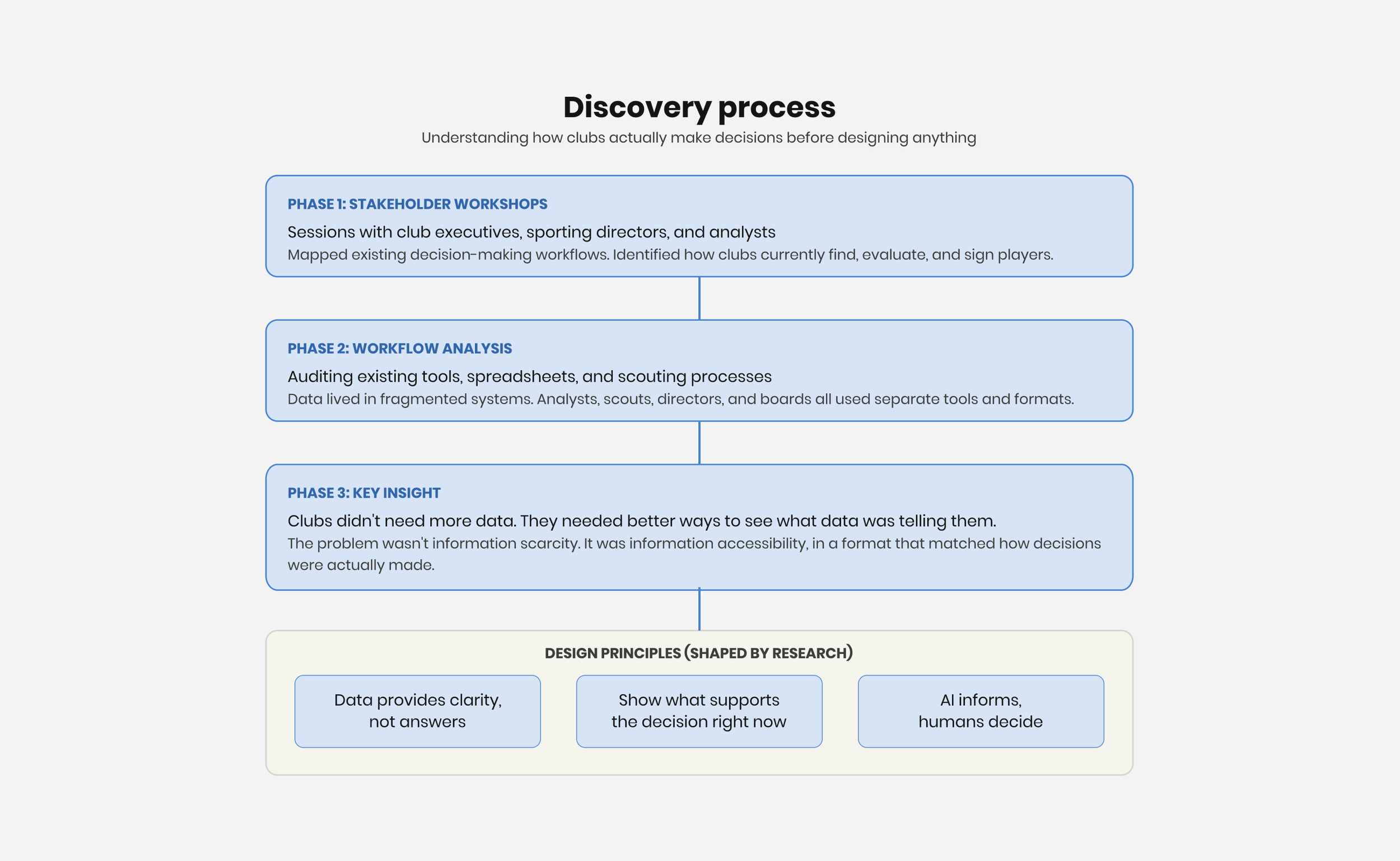
Before touching any screens, we needed to understand how football clubs actually make transfer and planning decisions. We ran workshops with club executives, sporting directors, and analysts to map existing workflows. How did they currently identify targets? What data did they trust? Where did the process break down?
What we found was that most clubs had data available to them, but it lived in spreadsheets, PDF reports, and separate scouting tools that didn't talk to each other. The decision-making process was fragmented: an analyst might surface a shortlist, a scout would watch the players, a sporting director would weigh in with their own contacts, and the board would approve based on budget. At no point was there a single view that brought all of this together.
The insight that shaped everything: clubs didn't need more data. They needed better ways to see what the data was telling them, in a format that matched how they actually made decisions, not how analysts thought about data.
PRODUCT STRATEGY
Three modules, one decision engine
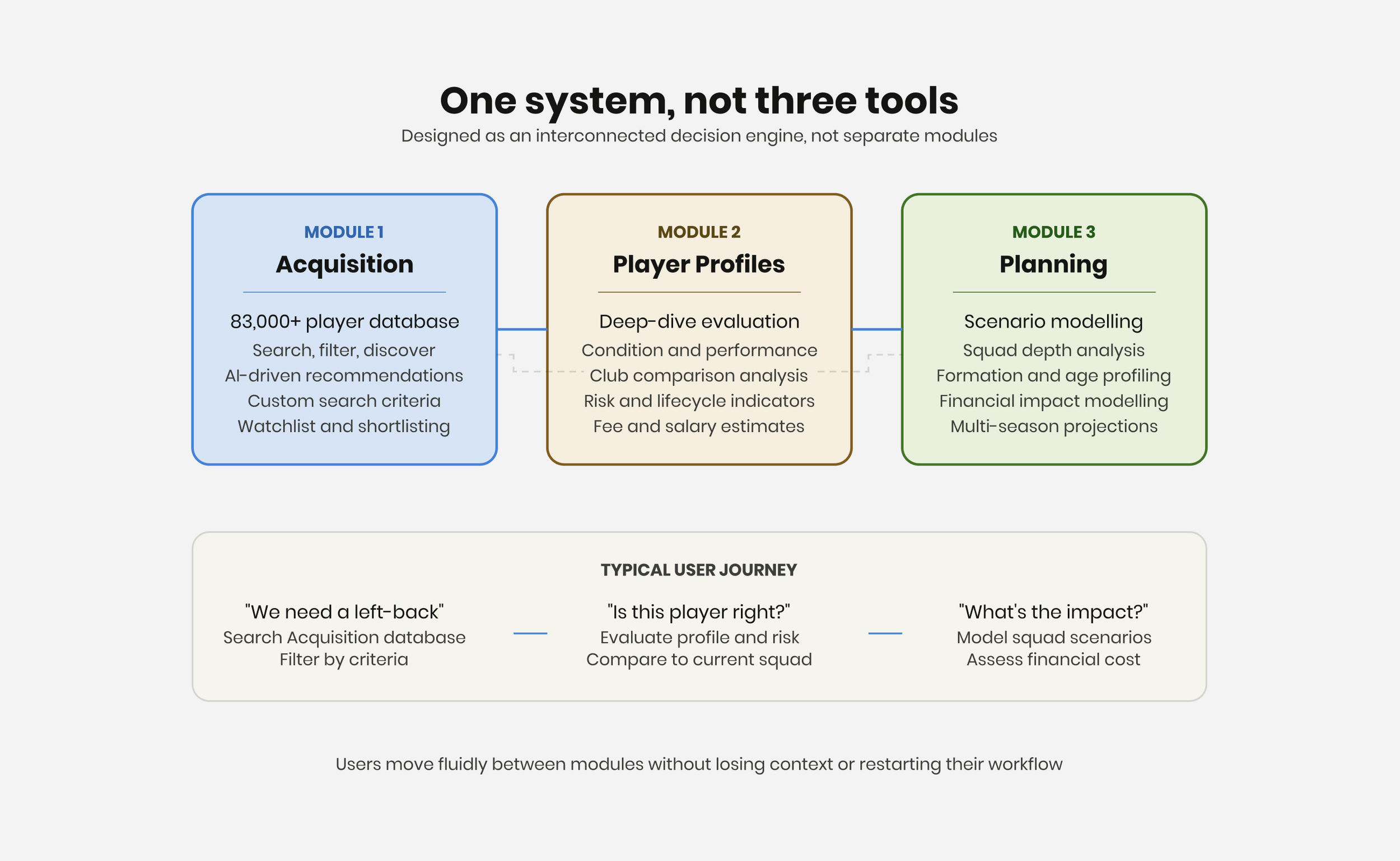
We structured Evolution around three core modules, each designed to support a different stage of the squad-building process:
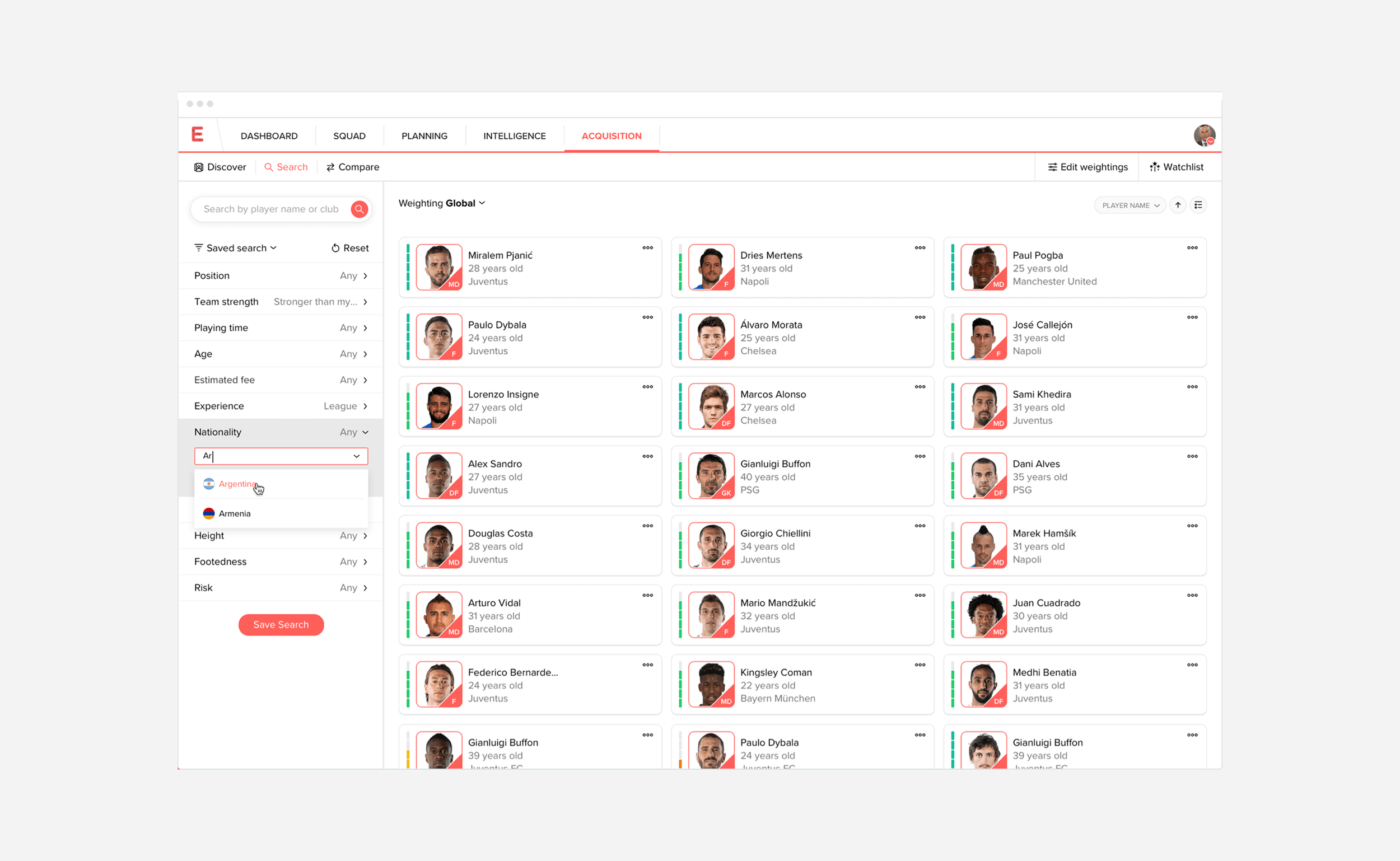
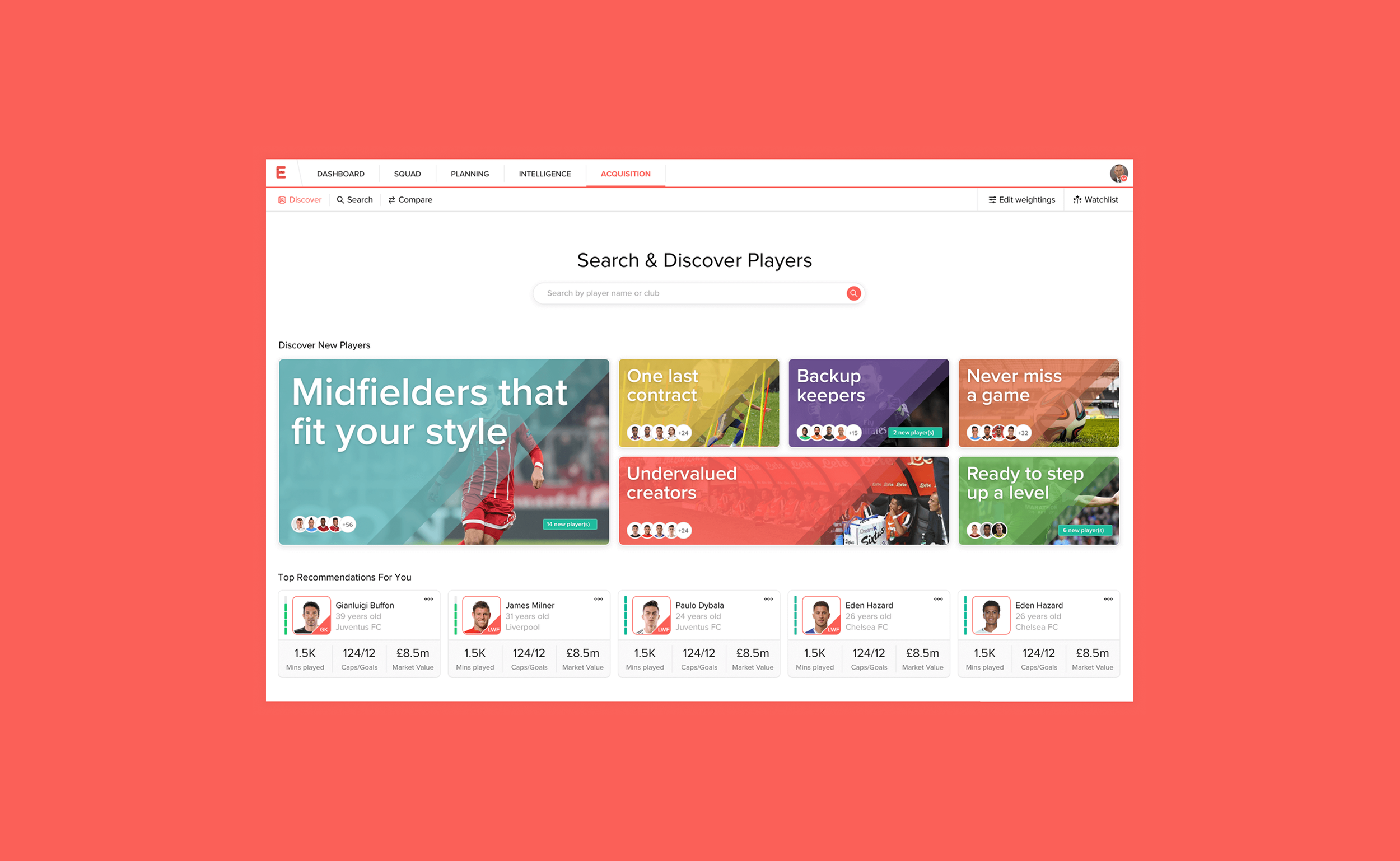
Acquisition — an 83,000+ player database where clubs could search, filter, compare, and discover players based on performance data, physique, market value, and AI-driven recommendations. This was the entry point for most users: "We need a left-back. Who should we be looking at?"
Planning — scenario planning tools that let clubs model their squad's future. What happens if we sell this player? What does our squad depth look like in two years? How does this signing affect our overall analytics profile? This module turned reactive buying into strategic planning.
Player Profiles — deep-dive evaluation pages for individual players, bringing together condition, performance, experience, and club comparison data. Every chart was designed to highlight risk and opportunity at a glance.
The key strategic decision was to design these as an interconnected system, not three separate tools. A user could discover a player in Acquisition, compare them against their current squad in Planning, and drill into the full profile, all within one continuous flow.
DESIGN PROCESS
Making complex data feel intuitive
The core design challenge across every module was the same: how do you present multi-variable, statistically complex data in a way that a non-technical executive can scan, understand, and act on in minutes?
We started with user flows for each module, mapping the key tasks: searching for a player, comparing two targets, building a scenario, evaluating risk. From there, we moved into wireframes focused on information hierarchy. What does a user need to see first? What can be progressive disclosure? What data requires a custom visualisation versus a standard chart?
I directed the team through multiple rounds of iteration, with a focus on reducing cognitive load at every step. The temptation with data-heavy products is to show everything because it's available. Our principle was the opposite: show only what supports the decision the user is trying to make right now.
Custom filtering for the Acquisition module
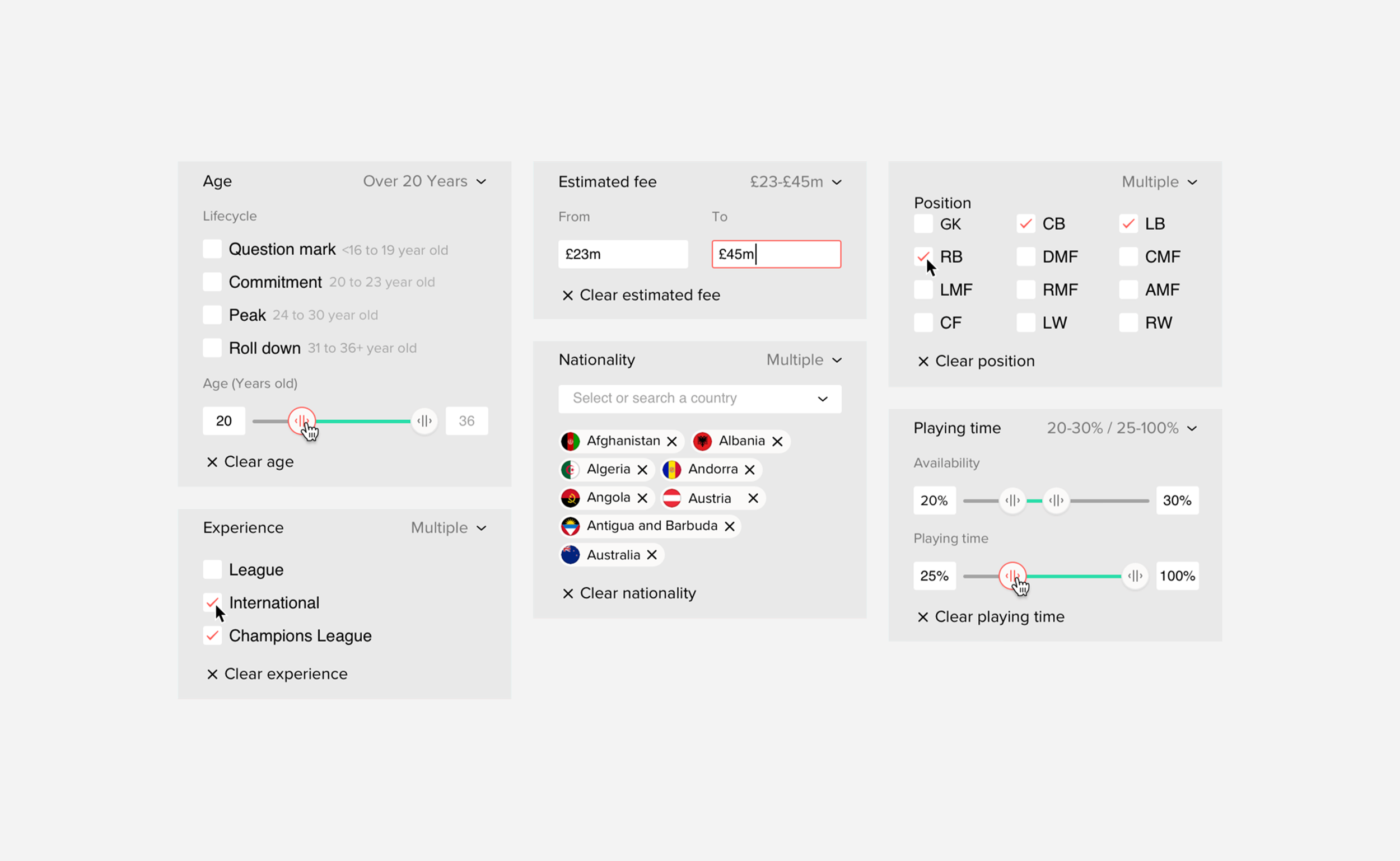
The Acquisition module's search and filtering system was one of the most complex design problems in the platform. Users needed to construct detailed search criteria across multiple data types: physical attributes, performance metrics, contract status, market value, age, position, and more.
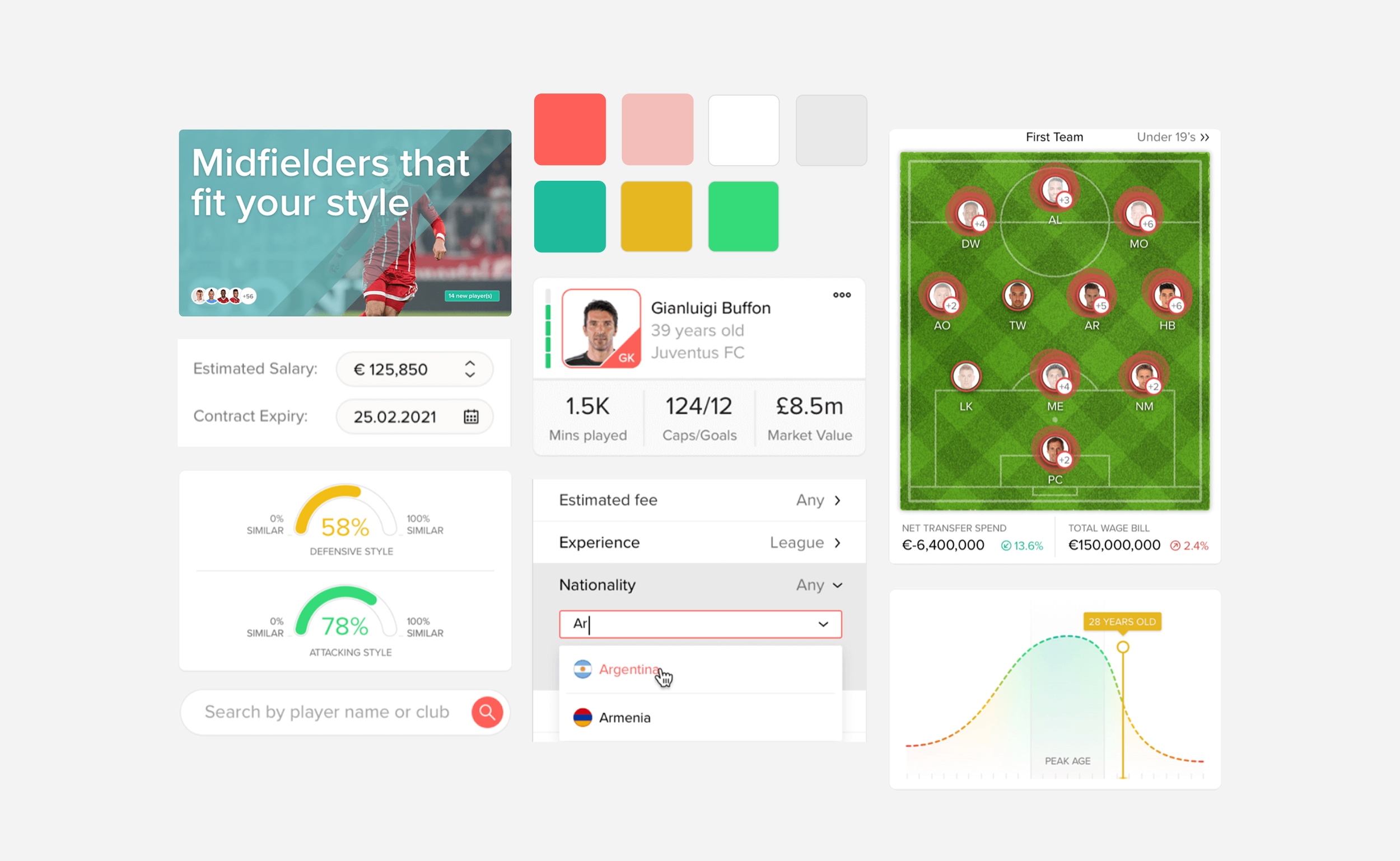
Each filter type required a custom UI solution that reflected the data appropriately. A slider for age ranges, a multi-select for positions, a threshold control for performance metrics. I directed the team to design a system where users could build sophisticated queries without it feeling like they were writing a database query. The filters needed to feel fast, responsive, and forgiving, updating results in real-time as criteria changed.
AI-DRIVEN RECOMMENDATIONS
Making AI trustworthy in high-stakes decisions
Evolution's AI-driven player recommendations were the platform's most powerful feature and its biggest design challenge. The analytical models could assess a player's physique, performance data, and market value to suggest targets that provided the best value for money at the lowest risk.
But recommending a £20M transfer based on an algorithm requires extraordinary trust. Sporting directors have decades of experience and strong instincts. They won't blindly follow an AI recommendation, and they shouldn't have to.
We designed the recommendation experience around transparency. Every suggestion showed why the player was recommended: which variables drove the recommendation, how the player compared to alternatives, and where the risk factors sat. The user could see the AI's reasoning and make their own judgment. The AI informed the decision. The human made it.
This was a deliberate design principle that carried across the entire platform: data provides clarity, not answers. The user is always in control.
PLAYER PROFILES
Designing for evaluation, not just information
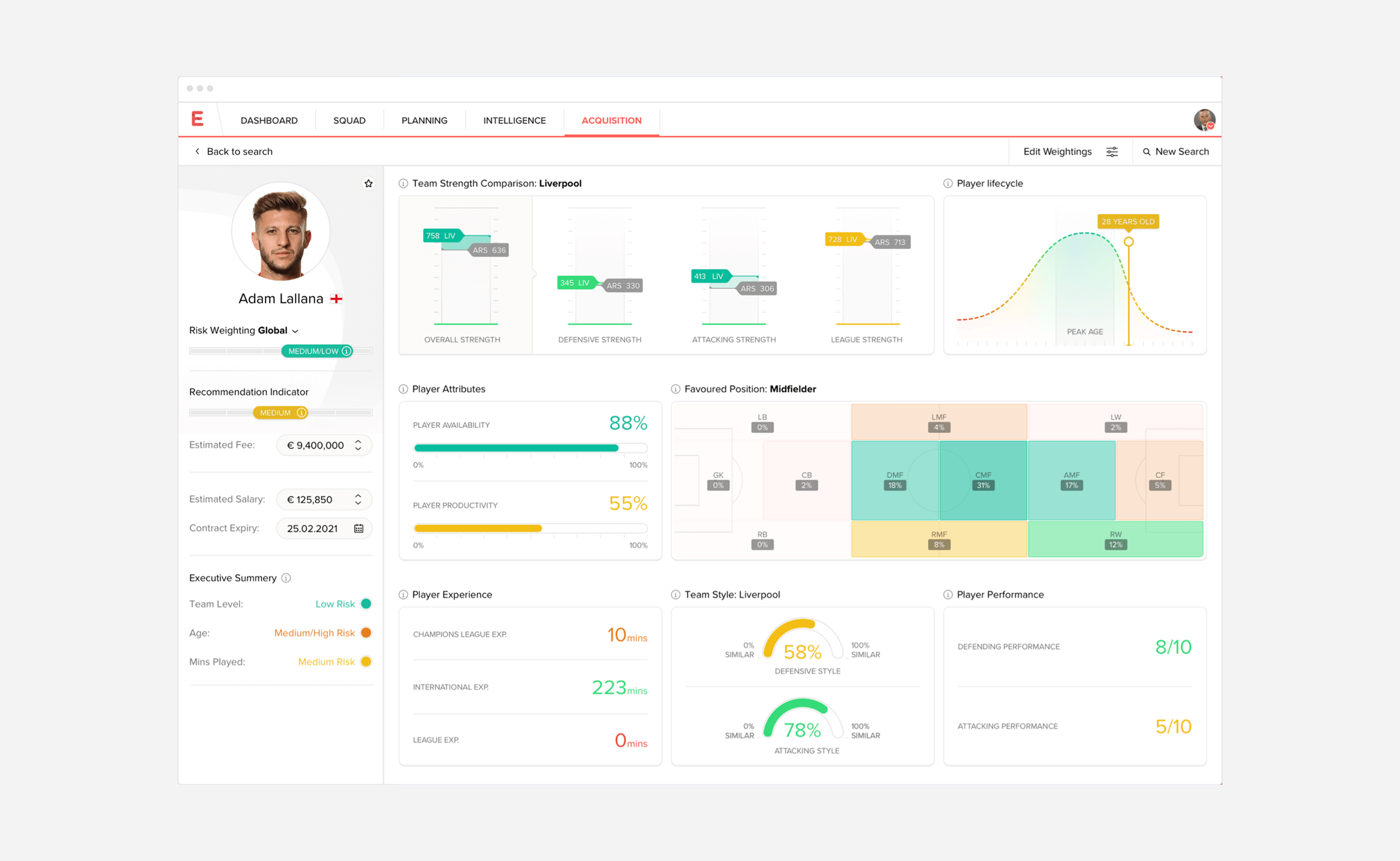
The player profile page was designed to support a specific task: evaluating whether this player is the right signing for your club. Every element on the page was organised around that question.
We structured the profile around four evaluation dimensions: condition, performance, experience, and club comparison. Each section used colour-coded visualisations to highlight risk (red) and opportunity (green) at a glance, so a user could scan the page and get an immediate read before diving into detail.
The club comparison section was particularly important. It showed how the target player's current club compared to the buying club across key metrics, giving context to the player's statistics. A player performing well at a lower-ranked club might perform differently at a Champions League team. The design surfaced that nuance visually rather than asking users to calculate it themselves.
SCENARIO PLANNING
Thinking in futures, not just transfers
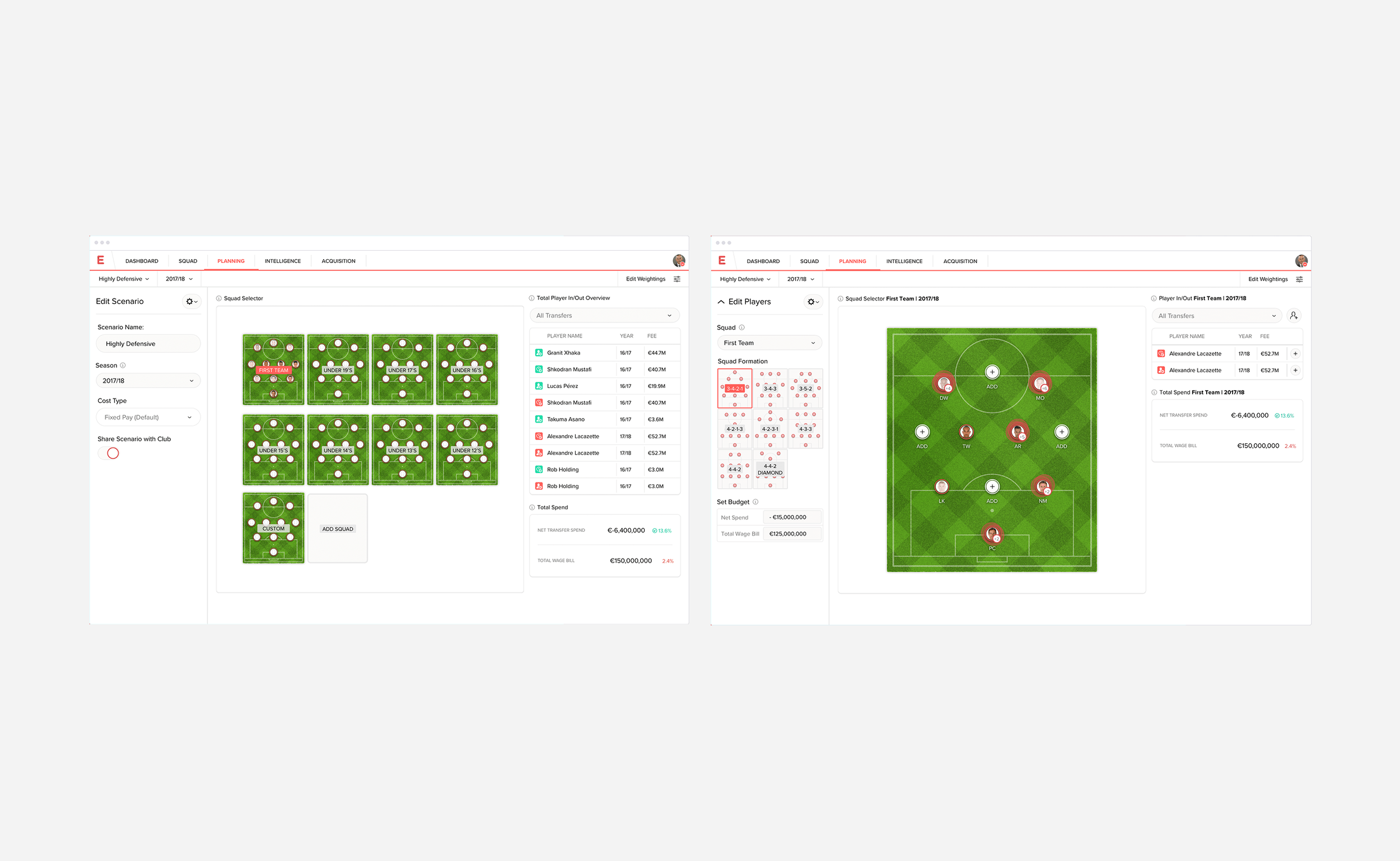
The Planning module moved Evolution beyond a search tool into a strategic planning platform. Clubs could model scenarios: what does our squad look like if we sell Player A and sign Player B? How does our age profile change over two years? Where are our depth gaps?
I directed the team to design this module around visual scenario comparison. Users could create multiple scenarios side by side and see the impact on financial, age, and squad depth analysis simultaneously. The interface needed to feel exploratory, not prescriptive. Clubs weren't looking for a single answer. They were looking for the best option among several possibilities.
MOBILE EXPERIENCE
Research on the go
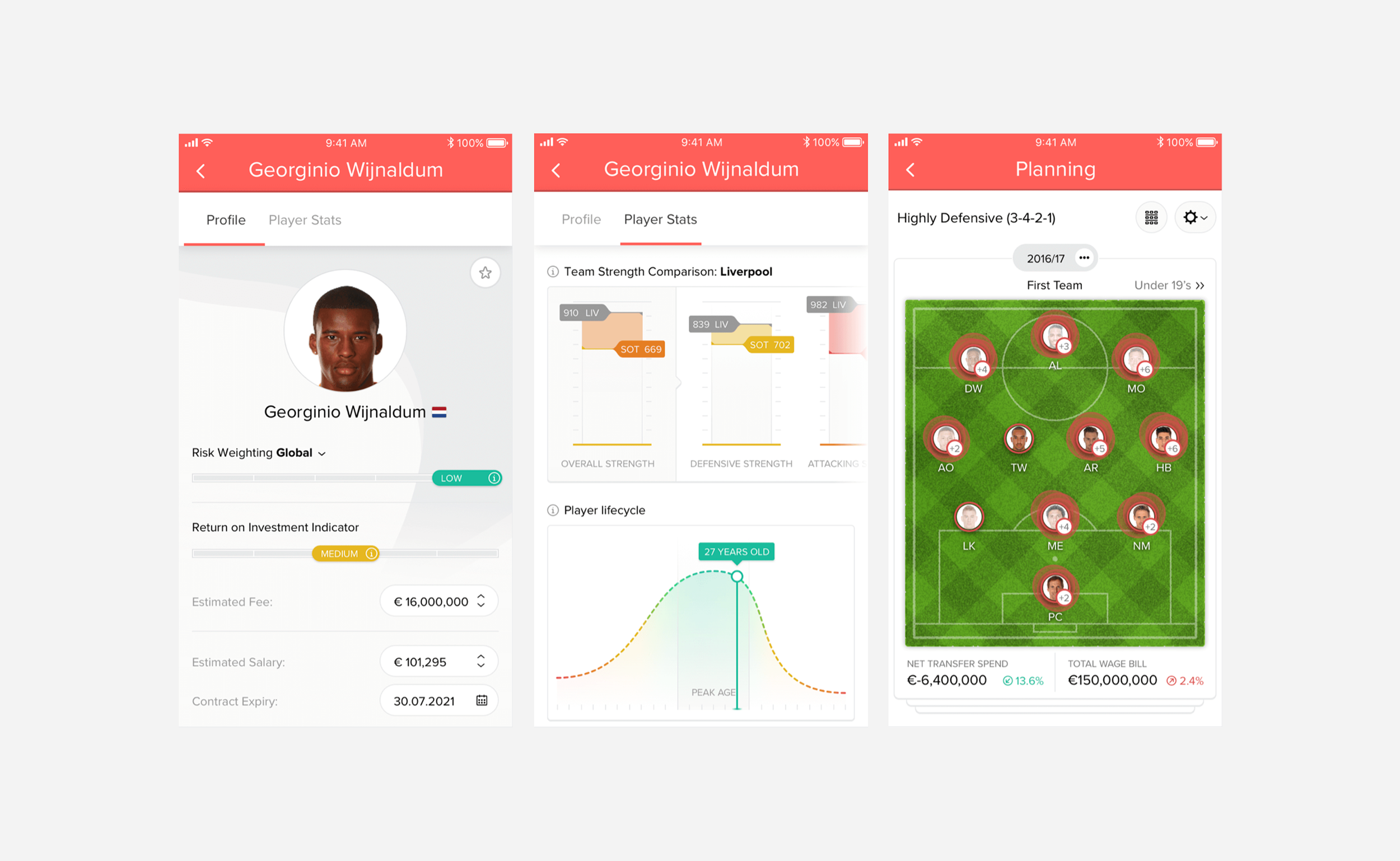
Evolution needed to work wherever decisions were being discussed: in the boardroom, at a match, on a scouting trip, or in transit. The mobile experience provided full feature parity with desktop, optimised for scanning and quick reference rather than deep analysis.
The mobile design focused on the most common on-the-go tasks: checking a player profile, reviewing a shortlist, or scanning a scenario. The data visualisations were redesigned for smaller viewports without losing the colour-coding and hierarchy that made the desktop experience scannable.
DESIGN SYSTEM
Consistency across a complex platform
With three modules, hundreds of data visualisation patterns, and multiple chart types, Evolution needed a robust design system to maintain consistency. I led the development of a component-based system covering typography, colour (including the risk/opportunity colour coding), chart styles, card patterns, filter components, and navigation.
The system was designed to scale: as new modules and features were added, the design team could compose new views from existing components without reinventing patterns. This reduced design and engineering time significantly and ensured that every part of Evolution felt like one product, not three separate tools stitched together.
IMPACT
Trusted by the world's leading football clubs
Evolution was adopted by leading football clubs globally, becoming an integral part of how they approached transfer strategy and squad planning. The platform transformed a process that was previously fragmented across spreadsheets, PDF reports, and subjective scouting networks into a single, data-driven decision engine.
The AI-driven recommendations helped clubs identify undervalued targets they would not have discovered through traditional scouting alone, while the scenario planning tools gave boardrooms the confidence to make long-term strategic decisions rather than reactive signings.
As Design Director, this project demonstrated that the most impactful product design isn't about making data look beautiful. It's about understanding the decision someone needs to make and designing the shortest, clearest path to that decision.
Role: Head of Design - product design strategy, team direction, UX direction, design system leadership, stakeholder management
Team: X2 Squads of 3 (UX Designer, UI Designer, Visual Designer) under my direction
Tools: Figma, Zeplin, Jira
Duration: 2019-2022
Status: Live, used by leading football clubs globally